


Understanding the Dental Implant Process: A Step-by-Step Guide
Losing a tooth, or finding out you're about to, can feel overwhelming. It's natural to have questions. Will I need surgery? Will it hurt? How long until I can smile and eat comfortably again?
We hear these questions every day. For more than 50 years, CharlottePerio's mission has been to help patients preserve their natural teeth whenever possible. When a tooth truly can't be saved, our board certified periodontists have decades of experience providing safe, precise, and predictable dental implants in Charlotte.
This guide walks you through exactly what to expect, from your first consultation with a periodontist in Charlotte to the day your smile is fully restored, so you can feel informed and confident every step of the way.
Key Takeaways
- Dental implants are titanium posts surgically placed in the jawbone to replace the root of a missing tooth. Once healed, they are topped with a custom restoration that looks, feels, and functions like a natural tooth.
- The dental implant process typically includes a consultation, tooth extraction (if needed), bone grafting (if needed), implant placement, healing and osseointegration, and your final restoration.
- Treatment timelines vary for every patient and can range from a few months to more than a year, depending on your bone health, healing, and whether bone grafting is recommended.
- A Board Certified periodontist specializes in the gums, bone, and supporting structures of the teeth, making them uniquely qualified to perform dental implant surgery and manage complex cases.
- At CharlottePerio, we work closely with your general dentist to provide coordinated, interdisciplinary care. This collaborative approach is considered the gold standard for achieving healthy, long lasting implant results.
What Is a Dental Implant, Exactly?
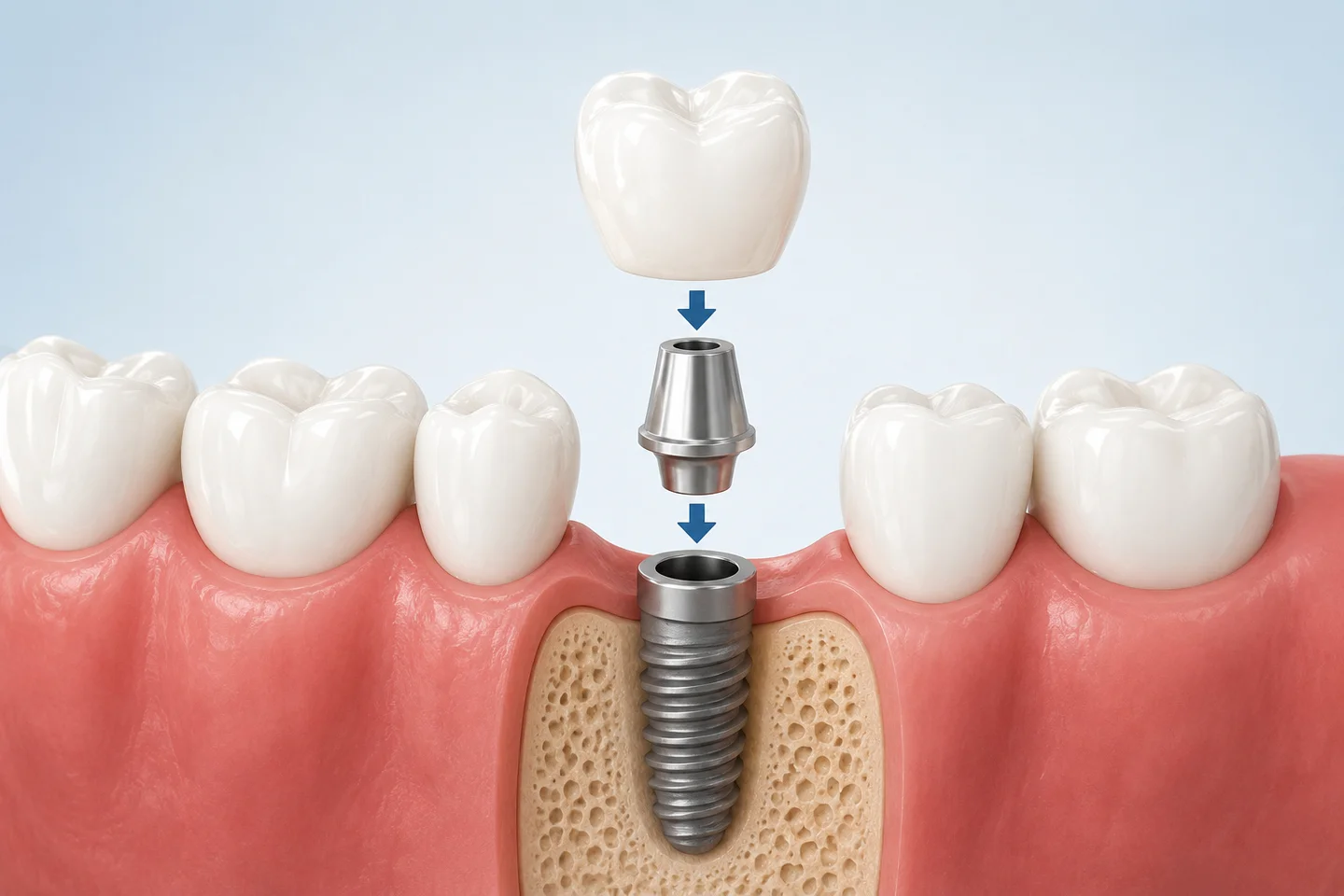
A dental implant is a small titanium or titanium alloy post that is surgically placed into the jawbone to replace the root of a missing tooth. As the implant heals, it fuses with the surrounding bone to create a strong, stable foundation for a custom restoration that looks, feels, and functions like a natural tooth.
Think of it like the foundation of a home. A strong foundation provides the stability needed for everything built above it. In the same way, a dental implant provides a secure foundation for your replacement tooth without relying on the surrounding teeth for support, as a traditional bridge does.
Why See a Periodontist for Dental Implants in Charlotte?
Many patients are surprised to learn that not every dentist who places dental implants specializes in implant surgery.
A periodontist completes several additional years of advanced training beyond dental school, with a focus on the gums, jawbone, and the supporting structures of the teeth. This specialized education makes a periodontist uniquely qualified to perform dental implant surgery, particularly when tooth extractions, bone loss, or bone grafting are part of the treatment plan.
At CharlottePerio, we believe exceptional outcomes come from collaboration. We work closely with your general dentist throughout the implant process. Your periodontist performs the surgical procedures, while your restorative dentist designs and places your final restoration. This interdisciplinary approach is considered the gold standard in implant dentistry because it combines the expertise of two dental specialists working together to achieve the best possible outcome for your long term oral health.
The Dental Implant Process, Step by Step
Step 1: Comprehensive Consultation and 3D Imaging
Every dental implant journey begins with a comprehensive examination and advanced 3D cone beam CT imaging. This technology allows us to evaluate your jawbone, surrounding teeth, nerves, and sinuses in remarkable detail, providing information that traditional two dimensional X rays cannot.
During your consultation, we'll also review your medical and dental history to determine whether any conditions, such as active periodontal disease or uncontrolled diabetes, should be addressed before implant treatment begins. Careful planning is one of the most important factors in achieving a successful, long lasting result.
Step 2: Tooth Extraction (If Needed)
If the tooth is still present but cannot be saved, it will need to be removed before implant placement. At CharlottePerio, we perform tooth extractions with your long term oral health in mind, carefully preserving as much healthy bone and gum tissue as possible to support future treatment.
In many cases, we recommend socket preservation, a bone graft placed immediately after the extraction to help maintain the natural shape of the jawbone and prepare the site for a future dental implant.
Step 3: Bone Grafting (If Needed)
Not every patient requires bone grafting, but it is a common part of implant treatment. After a tooth is lost, the jawbone naturally begins to shrink because it no longer receives stimulation from the tooth root.
Bone grafting helps rebuild areas where bone has been lost, creating a strong foundation for a dental implant. Depending on your needs, the graft may be performed at the time of extraction, during implant placement, or as a separate procedure before implant surgery.
Step 4: Dental Implant Placement
Once the treatment site is ready, the dental implant is precisely placed into the jawbone using advanced digital planning and the information gathered during your 3D imaging.
The procedure is typically performed using local anesthesia, and sedation options are available for patients who experience dental anxiety. Most implant procedures are completed in about an hour per implant.
Step 5: Osseointegration and Healing
After the implant is placed, your body begins a natural healing process called osseointegration. During this stage, the jawbone gradually fuses with the titanium implant, creating a stable, long lasting foundation for your replacement tooth.
Healing typically takes between three and six months, although every patient heals at a different pace. Throughout this process, we carefully monitor your progress to ensure the implant is healing properly before moving to the next stage.
Step 6: Final Restoration
Once healing is complete, a small connector called an abutment is attached to the implant. Your restorative dentist will then design a custom restoration that blends naturally with your surrounding teeth in shape, size, and color.
The finished restoration is securely attached to the implant, restoring your smile with a replacement tooth that looks, feels, and functions like a natural tooth.
Is the Procedure Painful?
One of the most common questions we hear is, "Will it hurt?"
Most patients are pleasantly surprised by how comfortable the procedure and recovery are. Many describe the experience as similar to, or even easier than, having a tooth extracted. Some swelling and mild soreness are normal during the first few days and can typically be managed with over the counter or prescribed pain medication, along with following your post operative instructions.
Every patient is different, and your comfort is always our priority. During your consultation, we'll discuss what you can expect based on your individual treatment plan and answer any questions you may have about the procedure or recovery.
Potential Risks and Important Considerations
Dental implants are one of the most predictable and successful tooth replacement options available, but like any surgical procedure, they are not without risk. Understanding these considerations helps you make an informed decision about your care.
Potential risks include:
- Implant failure, which occurs in a small percentage of cases and may be associated with factors such as inadequate bone support, infection, smoking, or certain medical conditions.
- The location of nerves and the maxillary sinuses must be carefully evaluated before treatment. Advanced 3D cone beam CT imaging allows us to precisely plan implant placement and minimize the risk of complications.
- Dental implants require an investment of time for proper healing and, in some cases, additional procedures such as bone grafting to create a strong foundation for long term success.
According to the American Academy of Periodontology, dental implants have a long term success rate generally cited above 90 to 95 percent when properly planned, placed, and maintained. At CharlottePerio, our Board Certified periodontists use advanced technology and evidence based treatment planning to help give every implant the best opportunity for long term success. That success also depends on a partnership between our team and you, including excellent oral hygiene, routine periodontal maintenance, regular follow up care, and a commitment to protecting your overall oral health.
Frequently Asked Questions
What does a periodontist in Charlotte actually do during the implant process?
A periodontist handles the surgical side of implant dentistry, including extractions, bone grafting, and the precise placement of the implant post itself. They typically work alongside a restorative dentist, who designs and attaches the final crown, creating a collaborative approach that covers both the surgical and cosmetic sides of treatment.
Who is a good candidate for dental implants?
Most adults with healthy gums, adequate jawbone density (or the ability to build it up via grafting), and well-managed overall health are good candidates. Conditions like uncontrolled diabetes, active periodontal disease, or heavy smoking can affect healing and should be discussed during your consultation.
Why is bone grafting sometimes necessary before an implant?
Bone grafting is recommended when there isn't enough healthy jawbone to securely support a dental implant. This most often happens after a tooth has been missing for an extended period, because the jawbone naturally begins to shrink when it no longer receives stimulation from the tooth root.
A bone graft helps rebuild and strengthen the area, creating a stable foundation for the implant to fuse with the surrounding bone. While not every patient needs bone grafting, it can play an important role in achieving a strong, long lasting result.
How much do dental implants in Charlotte typically cost?
Cost varies significantly based on how many implants are needed, whether extractions or bone grafting are required, and the type of final restoration. The most accurate way to get pricing is through an in-person consultation and imaging, since every treatment plan is different.
When can I eat normally again after getting an implant?
Most patients return to a soft-food diet within a few days of surgery and gradually reintroduce normal foods over the following weeks. Full biting force typically isn't recommended until after osseointegration is complete and the final crown is placed, which is usually several months out.
How do I know if I need an extraction before my implant, or if it can happen at the same time?
The answer depends on the condition of your tooth, the health of the surrounding bone and gum tissue, and your overall oral health. That's why a comprehensive exam and 3D cone beam CT imaging are the first steps in planning your treatment.
In some cases, a dental implant can be placed immediately after a tooth is extracted. In others, the area may need time to heal or require a bone graft before implant placement. Your periodontist will evaluate your individual situation and recommend the treatment approach that provides the best opportunity for long term success.
The Bottom Line
Choosing a dental implant is an important decision, but understanding the process can help you feel confident about your care. From your initial consultation and treatment planning to implant placement and your final restoration, every step is designed to create a healthy, stable, and long lasting result.
If you're considering dental implants in Charlotte, our Board Certified periodontists are here to guide you through your options and develop a treatment plan that's personalized to your needs. At CharlottePerio, we've spent more than 50 years helping patients preserve their oral health through specialized periodontal care, advanced technology, and close collaboration with their general dentists. Our goal is to help you restore your smile with results that look natural, function comfortably, and support your long term oral health.
Contact Us
We provide exceptional dental care tailored to your needs.
Contact Us at: (704) 365-0123
Fax: (704) 364-8640
Email: info@charlotteperio.com
Get in Touch
*Name
*Your Email
*Your Phone Number
Additional Information

Our Professional Affiliations




© 2026 CharlottePerio. All Rights Reserved | Notice of Privacy Practices | Digital Marketing by Remedo