


Dental Implants vs. Dentures vs. Bridges: Which Is Best?
Losing a tooth—or learning that one cannot be saved—can leave you with a lot of questions. Understanding your tooth replacement options is an important part of making a decision that's right for your oral health, your lifestyle, and your long-term goals.
At CharlottePerio, we've been helping patients restore their smiles for more than 50 years. One of the first things we explain during a consultation is that there is no one-size-fits-all solution. The best treatment depends on several factors, including your oral health, bone support, the number and location of missing teeth, your personal preferences, and your long-term goals.
This guide compares the most common tooth replacement options, including dental implants, bridges, and dentures, so you can better understand the benefits and considerations of each. Our goal is to provide the information you need to make a confident, informed decision about your care.
Key Takeaways
- Dental implants are the closest thing to a natural tooth and offer the best long-term outcomes, but they require surgery, adequate bone, and a higher upfront investment.
- Dental bridges are a faster, non-surgical option for replacing one to three teeth, but they require grinding down healthy neighboring teeth and don't preserve jawbone.
- Dentures (full or partial) are the most affordable and least invasive option, but they are the least stable, the least comfortable long-term, and accelerate jawbone loss.
- Implant-supported dentures and bridges combine the stability of implants with the coverage of traditional prosthetics, a powerful middle-ground option.
- There is no one-size-fits-all solution for replacing missing teeth. The best option depends on several factors, including your oral health, bone support, the number and location of missing teeth, your lifestyle, budget, and long-term goals.
- A board-certified periodontist is best positioned to evaluate which option is appropriate for your specific anatomy and health history.
Understanding Your Three Main Options
Before diving into the comparison, let's define each option clearly.
What is a dental implant?
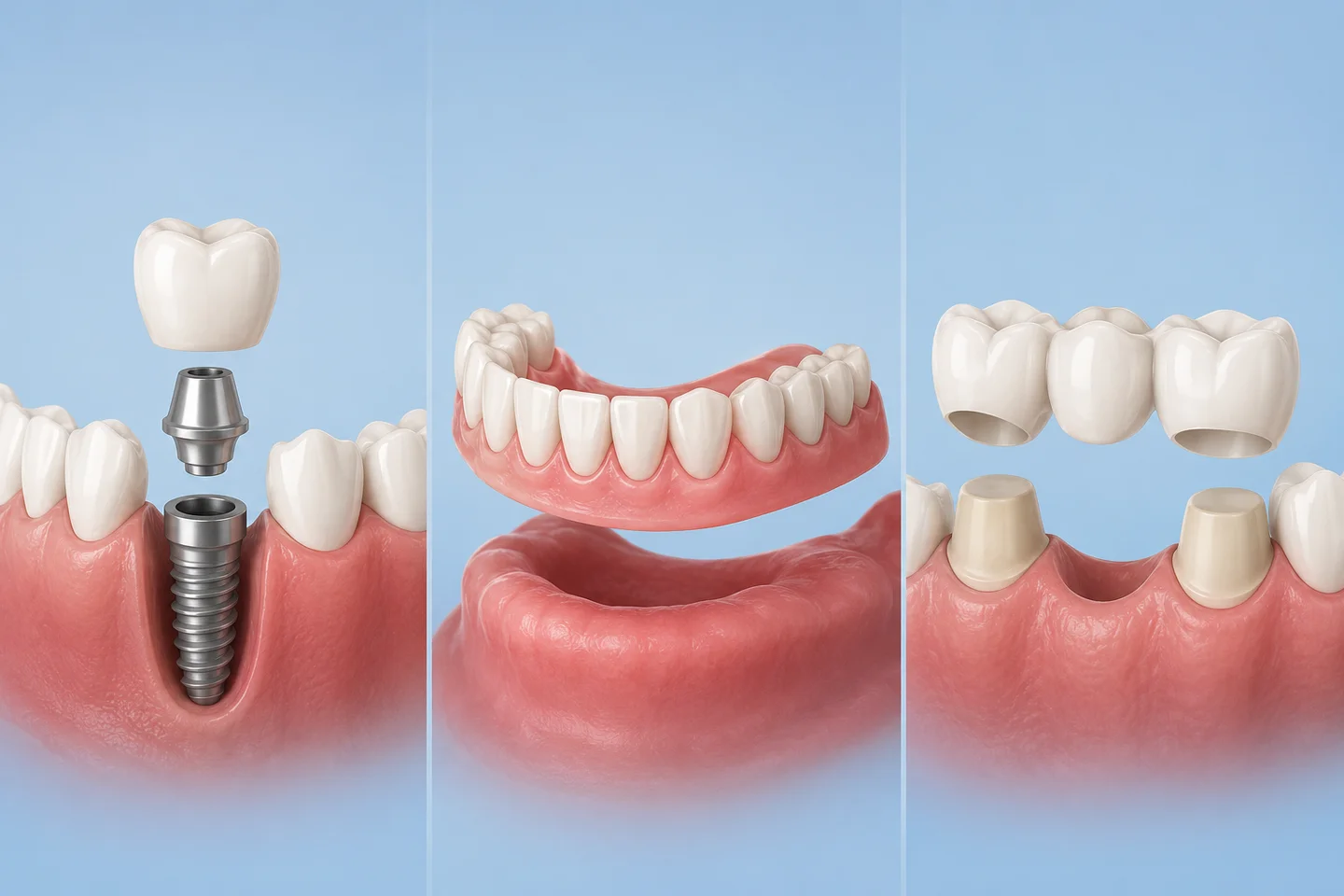
A dental implant is a titanium post surgically placed into the jawbone to act as an artificial tooth root, topped with a custom crown that looks and functions like a natural tooth.
What is a dental bridge?
A dental bridge is a fixed prosthetic that fills a gap by anchoring an artificial tooth (or teeth) to the natural teeth on either side of the space, which must be ground down to serve as supports.
What are dentures?
Dentures are removable prosthetic appliances that replace multiple missing teeth, either a full arch (complete dentures) or a section of missing teeth (partial dentures), and rest on the gum tissue.
Think of these three options on a spectrum: dentures are the simplest and most accessible entry point, bridges represent a middle ground of permanence and accessibility, and implants are the most sophisticated and durable solution. The right choice depends on your oral health, lifestyle, budget, and long-term goals.
Dental Implants vs. Dentures vs. Bridges: The Full Comparison
How Each Option Works
Dental Implants
The implant process unfolds in stages over several months:
- Surgical placement of the titanium post into the jawbone
- Osseointegration — a healing period of three to six months during which the implant fuses with the bone
- Abutment attachment — a connector piece placed on top of the healed post
- Crown placement — a custom-fabricated porcelain or zirconia crown is permanently secured
The result is a tooth replacement that is fixed, permanent, and functionally indistinguishable from a natural tooth for most daily activities.
Dental Bridges
A bridge is fabricated and placed in two to three dental visits:
- Tooth preparation — the healthy teeth on either side of the gap (called abutment teeth) are filed down significantly to accept crowns
- Impressions and temporary bridge — a temporary restoration protects the prepared teeth while the permanent bridge is fabricated
- Permanent bridge cementation — the final restoration is bonded into place
The bridge spans the gap with a pontic (artificial tooth) held in place by the crowns on the abutment teeth, like a suspension bridge anchored to two towers.
Dentures
Dentures are fabricated after any necessary extractions and initial healing:
- Complete dentures replace all teeth in an arch and are held in place by suction, adhesive, or implant attachments
- Partial dentures use metal clasps or precision attachments to anchor to remaining natural teeth
- Both types are removed for cleaning and typically worn during waking hours
Comparing Stability and Function
One of the biggest differences between dental implants, bridges, and dentures is how they feel and function during everyday activities like eating and speaking.
Dental implants provide the most stable and natural-feeling replacement because they are anchored directly into the jawbone. Once healed, they function much like natural tooth roots, allowing most patients to comfortably enjoy a wide variety of foods with confidence.
Dental bridges are also a fixed solution that provides good stability for chewing and speaking. Because a bridge rests on neighboring teeth rather than the jawbone, it does not replace the missing tooth root or stimulate the underlying bone.
Removable dentures restore the appearance of your smile and improve basic chewing function, but they are not attached to the jawbone. As a result, they may shift during eating or speaking, and changes in the jawbone over time can affect their fit. Many patients require periodic adjustments or replacement to maintain comfort.
In general, dental implants provide the greatest stability and chewing function, followed by bridges and then removable dentures. The best option for you depends on your oral health, the number of teeth being replaced, and your treatment goals.
Bottom line on stability: Implants > Bridges > Dentures
Comparing Impact on Jawbone
- One of the most important differences between dental implants, bridges, and dentures is how each option affects the health of your jawbone over time.
- When a natural tooth is lost, the jawbone in that area no longer receives the stimulation created by chewing. Without a tooth root to support it, the bone gradually begins to shrink—a natural process known as bone resorption. This loss of bone can affect the support for neighboring teeth, change the contours of your face, and make future tooth replacement more challenging.
- Dental implants are the only tooth replacement option that replaces both the visible tooth and its root. Because the implant is anchored within the jawbone, it helps stimulate the bone during chewing and can significantly reduce the bone loss that typically follows tooth loss. Preserving the jawbone is one of the greatest long-term benefits of dental implants.
- Dental bridges replace the visible portion of a missing tooth but do not replace the root. While they restore appearance and function, the jawbone beneath the replacement tooth continues to lose volume over time because it is no longer being stimulated.
- Removable dentures also rest on top of the gums rather than within the jawbone. As the underlying bone naturally changes shape over the years, dentures may become loose and require periodic adjustments or replacement. Ongoing bone loss can also contribute to changes in facial appearance and make it more difficult to achieve a stable denture fit over time.
- If preserving your jawbone is an important long-term goal, dental implants are the only treatment option that helps maintain the bone where the tooth was lost.
Bottom line on bone preservation: Implants | Bridges | Dentures
Comparing the Impact on Neighboring Teeth
Another important consideration is how each tooth replacement option affects the healthy teeth around it.
Dental implants are completely self-supporting and do not rely on neighboring teeth for support. Because they replace the missing tooth independently, the adjacent teeth remain untouched. This is one of the key advantages of dental implants, particularly when the surrounding teeth are healthy.
Dental bridges are supported by the teeth on either side of the missing tooth. To place a bridge, these neighboring teeth are typically reshaped to accommodate dental crowns. While bridges are a reliable and effective treatment option for many patients, this process requires the permanent removal of healthy tooth structure. Over time, the supporting teeth may also be more susceptible to wear or require additional dental treatment.
Removable partial dentures use metal or tooth-colored clasps that attach to neighboring teeth for stability. While they can be an effective and conservative way to replace missing teeth, the supporting teeth require regular monitoring and good oral hygiene to help prevent plaque buildup, decay, and excessive wear.
If preserving healthy neighboring teeth is a priority, dental implants offer the advantage of replacing a missing tooth without altering the surrounding natural teeth.
Bottom line on protecting healthy teeth: Implants > Dentures (partial) > Bridges
Comparing the Procedure and Recovery
The treatment process and recovery experience vary depending on the tooth replacement option you choose.
Dental implants require a minor surgical procedure to place the implant into the jawbone. Treatment is performed under local anesthesia, and sedation options are available for patients who prefer additional comfort. Most patients return to their normal routine within a few days, although the implant and surrounding bone require several months to heal and integrate before the final restoration is placed. Depending on whether procedures such as bone grafting are needed, the complete treatment process typically takes three to twelve months.
Dental bridges do not require surgery and are usually completed over two or three appointments within a few weeks. After the supporting teeth are prepared, it's common to experience mild sensitivity for a short time while adjusting to the new restoration.
Removable dentures generally do not require surgery unless teeth need to be extracted beforehand. Creating a well-fitting denture often involves several appointments for impressions, fittings, and adjustments. It's also normal to need a period of adaptation as you become comfortable eating and speaking with your new dentures.
While dental implants involve the longest treatment timeline, they are also designed to provide the most natural function and long-term support. During your consultation, we'll review the expected timeline for your specific situation so you know what to expect every step of the way.
Implant-Supported Dentures and Bridges: The Best of Both Worlds?
It's worth highlighting a category that sits between these options and represents one of the most exciting developments in modern tooth replacement.
What are implant-supported dentures? Implant-supported dentures are removable or fixed full-arch prosthetics that attach to two to six dental implants rather than resting on gum tissue, providing dramatically better stability, comfort, and bone preservation than conventional dentures.
For patients who need to replace a full arch of teeth, implant-supported options, including All-on-4 and All-on-6 protocols, offer a transformative upgrade over traditional dentures. Rather than a plate that shifts and requires adhesive, patients receive a fixed, implant-anchored restoration that functions with natural-feeling confidence.
Similarly, implant-supported bridges replace multiple adjacent teeth using implants as anchors instead of natural teeth, preserving the neighboring teeth from being ground down.
At CharlottePerio, our board-certified periodontists are committed to staying at the forefront of implant dentistry through ongoing continuing education and clinical research. From replacing a single missing tooth to restoring an entire arch, we offer a full range of modern implant solutions tailored to each patient's needs. During your consultation, we'll discuss all of your treatment options and recommend the approach that best supports your long-term oral health and goals.
Which Tooth Replacement Option Is Right for You?
The best tooth replacement option depends on your oral health, the number and location of missing teeth, your overall health, and your long-term goals. While every patient is unique, the following guidelines can help explain when each treatment may be recommended.
Replacing a Single Missing Tooth
→ Dental Implant
In many cases, a dental implant is the preferred option. Because it replaces both the tooth and its root, an implant preserves the neighboring teeth, helps maintain the jawbone, and provides the most natural function and appearance.
Replacing Two or More Adjacent Missing Teeth
→ Dental Implant(s) or Implant-Supported Bridge
Dental implants, an implant-supported bridge, or a traditional bridge may all be appropriate options. The best choice depends on factors such as the health of the neighboring teeth, the amount of available bone, and whether existing crowns or restorations are already present. During your consultation, we'll recommend the treatment that provides the best long-term outcome for your specific situation.
Replacing All of the Teeth in an Arch
→ Implant-Supported Denture (All-on-4 or All-on-6)
Implant-supported dentures are often an excellent solution for patients missing all of their upper or lower teeth. By securing the denture to dental implants, this treatment provides greater stability, improved chewing function, and better support for the jawbone than a traditional removable denture. Conventional dentures remain a reliable option for many patients and may be recommended based on individual needs and preferences.
When Budget Is an Important Consideration
Every patient has different financial considerations, and we'll work with you to find the treatment that best fits your needs. While dental implants often provide the greatest long-term benefits, dental bridges and removable dentures remain effective, time-tested solutions for replacing missing teeth. We'll help you understand the advantages, limitations, and long-term considerations of each option so you can make an informed decision.
When Surgery Isn't the Best Option
Some medical conditions or treatments may make dental implant surgery inappropriate or require it to be postponed. In these situations, a dental bridge or removable denture may be the better choice. Our board-certified periodontists will review your medical history, collaborate with your healthcare providers when needed, and recommend the safest and most appropriate treatment for your overall health.
At CharlottePerio, our goal isn't to recommend the same treatment for every patient—it's to recommend the right treatment for you.
When Budget Is the Primary Consideration
A dental bridge or removable denture may be the most practical option. While dental implants often provide the greatest long-term benefits, bridges and dentures remain effective, time-tested solutions for replacing missing teeth. During your consultation, we'll discuss the upfront costs, long-term maintenance, expected lifespan, and potential impact on your oral health so you can make an informed decision that's right for you.
When Surgery Isn't the Best Option
A dental bridge or removable denture may be recommended instead of a dental implant. Certain medical conditions or treatments may make implant surgery inappropriate or require it to be postponed. Our board-certified periodontists will carefully review your medical history, collaborate with your physician when needed, and recommend the safest and most appropriate treatment for your individual situation.
Understanding the Considerations of Each Option
Every tooth replacement option has advantages and limitations. Our goal is to help you understand the trade-offs so you can choose the treatment that best fits your needs, lifestyle, and long-term goals.
Dental Implants
Dental implants offer many long-term benefits, but they may not be the right choice for every patient. Considerations include:
- Higher initial investment than bridges or dentures.
- A minor surgical procedure and several months of healing before the final restoration is placed.
- Some patients may require preparatory treatment, such as periodontal therapy or bone grafting, before implant placement.
- The overall treatment timeline is typically longer than with bridges or dentures.
Dental Bridges
Dental bridges provide a fixed, non-surgical solution for many patients. Considerations include:
- The neighboring teeth usually need to be reshaped to support the bridge.
- The jawbone beneath the missing tooth is not stimulated and may gradually lose volume over time.
- Cleaning around a bridge requires specialized floss or other cleaning aids.
- Bridges may need to be repaired or replaced over time, depending on oral health and normal wear.
Removable Dentures
Dentures remain an effective treatment option for many patients, particularly when replacing multiple teeth. Considerations include:
- They provide less stability than fixed options and may shift during eating or speaking.
- Changes in the jawbone over time can affect the fit, making periodic adjustments or replacement necessary.
- Conventional dentures are removed daily for cleaning and while sleeping.
- Some patients find they need to adapt their diet or avoid certain foods to improve comfort and chewing.
Each of these treatment options has an important place in dentistry. During your consultation, we'll help you weigh the benefits and considerations of each so you can make the choice that's best for your smile and your long-term oral health.
The Bottom Line: Dental Implants vs. Dentures vs. Bridges
Every tooth replacement option has an important role in modern dentistry. The best choice depends on your oral health, the number and location of missing teeth, your overall health, your lifestyle, and your long-term goals.
For many patients, dental implants offer the greatest long-term benefits. Because they replace both the tooth and its root, they help preserve the jawbone, protect neighboring teeth, and provide the most natural function and appearance. However, dental bridges and removable dentures continue to be excellent treatment options in the right situations and may be the better choice for some patients.
At CharlottePerio, we believe the best treatment plan is one that's personalized to you. During your consultation, our board-certified periodontists will perform a comprehensive evaluation, discuss all of your treatment options, and explain the benefits and considerations of each so you can make an informed decision with confidence.
Whether you're replacing a single missing tooth or restoring an entire smile, our goal is to help you choose the solution that best supports your long-term oral health, function, and quality of life. Schedule a consultation with our team today.
Frequently Asked Questions
Which lasts longer dental implants, bridges, or dentures?
Dental implants have the longest lifespan of the three options, routinely lasting 20 to 25 years and often a lifetime with proper care — only the crown may need replacement after 15 to 20 years. Dental bridges typically last 10 to 15 years before needing replacement, often sooner if complications develop in the supporting teeth. Dentures have the shortest functional lifespan of five to ten years before requiring relining, rebasing, or full replacement as the jawbone changes shape beneath them.
Why do dentists prefer dental implants over bridges and dentures?
Most periodontists prefer dental implants for eligible patients because implants are the only option that preserves jawbone, requires no modification to neighboring teeth, and delivers the most natural long-term function and appearance. According to the American Academy of Periodontology, implants represent the standard of care for single-tooth and multi-tooth replacement in suitable candidates. That said, implants are not appropriate for every patient; health status, bone availability, and budget all factor into the recommendation.
Can you convert from dentures to dental implants later?
Yes. Many patients who have worn dentures for years successfully transition to implant-supported dentures or, in some cases, individual dental implants. The best option depends on your oral health, the amount of remaining jawbone, and your treatment goals.
One important consideration is that the jawbone naturally shrinks over time after teeth are lost. Because conventional dentures rest on the gums and do not stimulate the underlying bone, wearing dentures for many years can result in additional bone loss. In some cases, bone grafting may be recommended before dental implants can be placed.
If you're considering dental implants in the future, it's worth having a conversation sooner rather than later. An evaluation with one of our board-certified periodontists can help determine how much bone is available today and whether there are steps that can help preserve your options for the future.
Are dental implants worth the extra cost compared to a bridge?
For many patients, dental implants provide the greatest long-term value. Although they typically have a higher upfront cost, implants are designed to replace both the tooth and its root, helping preserve the jawbone and leaving neighboring teeth untouched. Dental bridges remain an excellent treatment option in many situations, but they may require replacement over time and rely on adjacent teeth for support. During your consultation, we'll discuss the short- and long-term considerations of each option so you can choose the solution that best fits your oral health, lifestyle, and budget.
How do I decide between a dental implant and a bridge?
The best choice depends on several factors, including the health of the neighboring teeth, the amount of available jawbone, your overall oral health, and your treatment goals. If the adjacent teeth are healthy, a dental implant often provides the greatest long-term benefit because it preserves those teeth and helps maintain the jawbone. If neighboring teeth already need crowns or extensive restoration, a bridge may be an appropriate option. A comprehensive evaluation, including advanced imaging when needed, allows us to recommend the treatment that's best for your unique situation.
What is the most natural-feeling tooth replacement?
Dental implants are widely considered the most natural-feeling tooth replacement because they are anchored directly into the jawbone, much like a natural tooth root. This provides excellent stability for chewing and speaking, and many patients report that, once fully healed, their implant feels much like a natural tooth. Individual experiences vary, but dental implants generally offer the closest replacement to the look, feel, and function of a healthy natural tooth.
Who should I see to discuss dental implants, bridges, or dentures?
If you're exploring your tooth replacement options, a board-certified periodontist can provide a comprehensive evaluation of your gums, jawbone, and overall oral health. With advanced training in periodontal health, bone grafting, and dental implant surgery, periodontists are uniquely qualified to determine whether dental implants are appropriate and whether any preparatory treatment is needed before implant placement.
At CharlottePerio, our board-certified periodontists use advanced imaging technology and evidence-based treatment planning to help you understand all of your options. We work closely with your general dentist to develop a personalized treatment plan that supports your long-term oral health and provides the best possible outcome for your smile.
Contact Us
We provide exceptional dental care tailored to your needs.
Contact Us at: (704) 365-0123
Fax: (704) 364-8640
Email: info@charlotteperio.com
Get in Touch
*Name
*Your Email
*Your Phone Number
Additional Information

Our Professional Affiliations





© 2026 CharlottePerio. All Rights Reserved | Notice of Privacy Practices | Digital Marketing by Remedo