


Is It Time to Replace Your Dentures With Dental Implants?
For many denture wearers, everyday moments like enjoying a meal, laughing with friends, or speaking in public can come with concerns about comfort, stability, or confidence. If you've ever wondered whether there's a better solution, you're not alone.
At CharlottePerio, we've spent more than 50 years helping patients restore their smiles and improve their quality of life. During that time, advances in dental implant technology have transformed the options available for replacing missing teeth. Today, many patients who once relied on traditional dentures can enjoy greater stability, improved chewing function, and renewed confidence with implant-supported tooth replacement.
One of the most common questions we hear is, "Have I worn dentures for too long to get dental implants?" In many cases, the answer is no. Even if you've been wearing dentures for years, modern treatment techniques, including bone grafting when appropriate, may make dental implants a possibility. The first step is a comprehensive evaluation to determine which treatment options are right for your individual needs.
Key Takeaways
- Many patients successfully replace traditional dentures with implant-supported tooth replacement.
- Dental implants provide greater stability, improved chewing function, and help preserve the jawbone in ways that conventional dentures cannot.
- The jawbone naturally shrinks over time after tooth loss, so wearing dentures for many years can make treatment more complex. However, this does not necessarily mean dental implants are no longer an option.
- Many denture wearers are candidates for dental implants or implant-supported dentures, even if they've been told they have bone loss.
- Modern bone grafting procedures can often rebuild lost bone and create a healthier foundation for dental implants when appropriate.
- There is no upper age limit for dental implants. Overall health, bone support, and gum health are much more important than age alone.
- A comprehensive evaluation with one of our board-certified periodontists is the best way to determine which treatment options are right for you.
Why Denture Wearers Start Looking for Alternatives
Traditional dentures have helped millions of people restore their smiles and improve their ability to eat and speak. They remain an effective treatment option for many patients. However, it's not uncommon for denture wearers to notice changes over time that affect their comfort, confidence, and quality of life.
If you're experiencing any of the following, it may be time to explore whether implant-supported tooth replacement could be a better long-term solution.
Your Dentures No Longer Fit Comfortably
One of the most common concerns we hear is, "My dentures just don't fit like they used to."
In many cases, the denture isn't the problem—it's the jawbone beneath it. After teeth are lost, the jawbone naturally begins to shrink because it no longer receives the stimulation provided by natural tooth roots. As the shape of the jaw changes, even a well-made denture can become loose, shift during daily activities, or create sore spots.
Relining or replacing a denture can improve the fit temporarily, but it does not stop the underlying bone loss. Dental implants are the only tooth replacement option that helps preserve the jawbone by replacing the function of the missing tooth roots.
Eating Has Become More Difficult
Dentures can restore basic chewing function, but many patients find they begin avoiding certain foods over time. Tough meats, crunchy vegetables, crusty bread, and other firm foods may become more difficult to eat comfortably, especially if dentures have become loose.
If you've started changing your diet because of your dentures, it's worth discussing your options. Implant-supported tooth replacement provides greater stability and chewing efficiency, allowing many patients to enjoy a wider variety of foods with greater confidence.
You're Relying More on Denture Adhesive
Denture adhesive can provide additional confidence for some patients, but needing larger amounts or applying it multiple times throughout the day often indicates that the denture no longer fits as it should.
Because the jawbone continues to change over time, adhesive can only compensate for so much. A comprehensive evaluation can help determine whether your denture can be adjusted or whether a more stable solution may be appropriate.
You're Less Confident When Eating, Speaking, or Smiling
Many denture wearers worry about their dentures moving while talking, laughing, or eating in public. Even small concerns about stability can affect confidence and lead some people to avoid social situations or certain foods.
If your dentures are preventing you from enjoying everyday activities, it's important to know that additional treatment options may be available. Implant-supported dentures offer significantly greater stability and can help many patients feel more comfortable in social settings.
You've Noticed Changes in Your Facial Appearance
Tooth loss affects more than your smile. As the jawbone gradually loses volume, it provides less support for the lips and lower face. Over time, this can contribute to changes in facial contours and the appearance of premature aging.
Because dental implants help preserve the jawbone, they can play an important role in maintaining facial support while replacing missing teeth.
If any of these changes sound familiar, you're not alone. Many patients assume these challenges are simply part of wearing dentures, but they don't have to be. A consultation with one of our board-certified periodontists can help determine whether implant-supported tooth replacement could provide a more comfortable, stable, and long-lasting solution for your smile.
What Replacing Dentures With Dental Implants Looks Like
When patients ask about replacing their dentures with dental implants, they're often surprised to learn there isn't just one solution. Today's implant treatments range from securing an existing denture to replacing an entire arch with a fixed set of teeth.
The right option depends on several factors, including your oral health, the amount of available jawbone, your treatment goals, and your budget.
Implant-Supported Overdentures
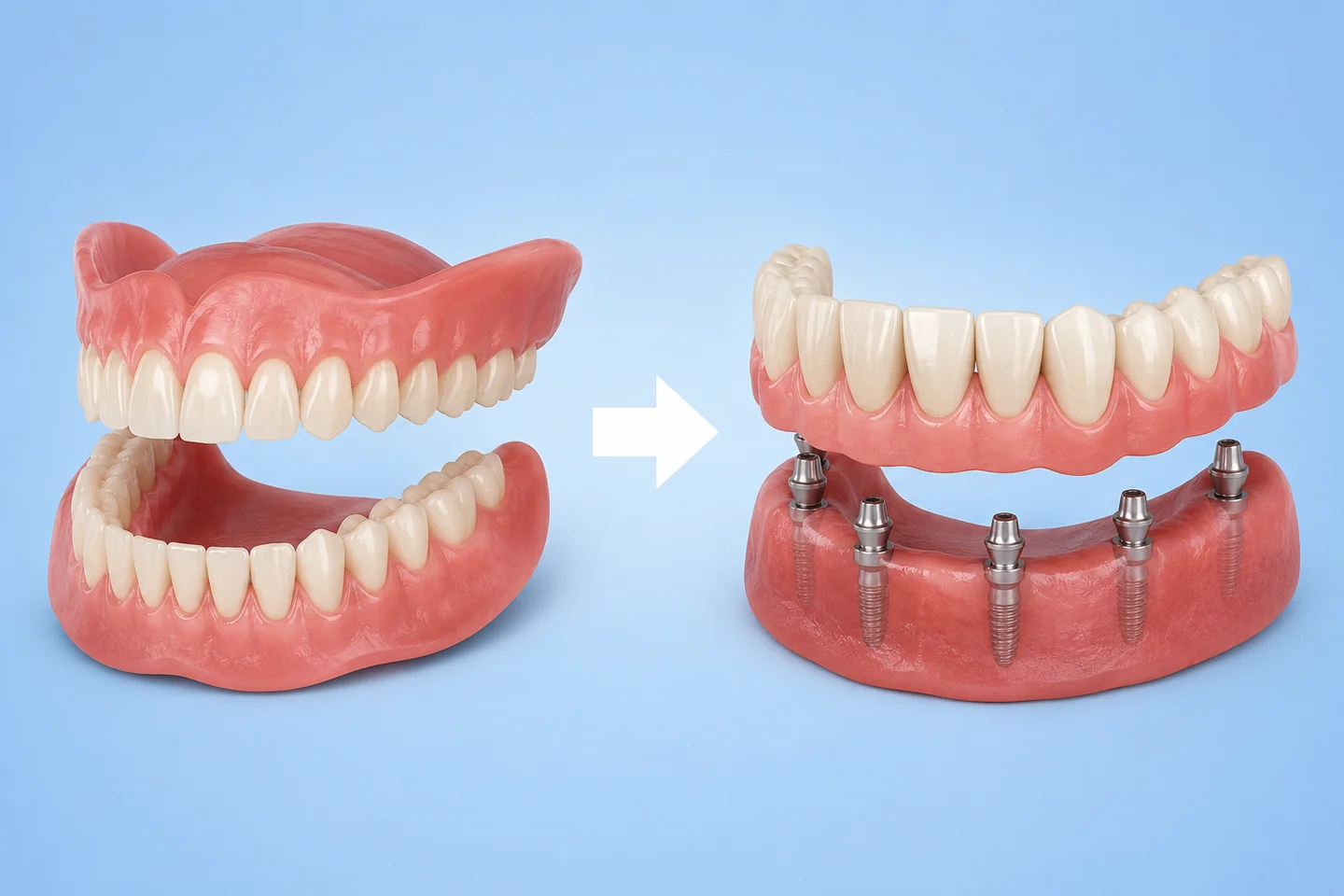
An implant-supported overdenture is one of the most common options for patients replacing a full denture. Two to four dental implants are placed in the jawbone to anchor a specially designed denture that securely snaps into place.
Compared with a conventional denture, an implant-supported overdenture provides significantly greater stability for eating and speaking while helping preserve the jawbone around the implants. The denture remains removable, making it easy to clean while offering much greater confidence during everyday activities.
Fixed Implant-Supported Full-Arch Restoration
For patients seeking the most stable and natural-feeling solution, a fixed implant-supported full-arch restoration may be recommended. Often supported by four to six strategically placed dental implants, this treatment permanently secures a full arch of replacement teeth that is not removed by the patient.
Many patients appreciate the ability to eat a wider variety of foods, speak with confidence, and enjoy a smile that closely resembles the look and function of natural teeth. Because the implants stimulate the jawbone, they also help preserve the bone that supports the restoration.
Individual Dental Implants
Some denture wearers may not need to replace an entire arch. If you're missing only a few teeth—or if your treatment plan allows—individual dental implants may be the best solution. Each implant replaces a single missing tooth without relying on neighboring teeth for support, providing a stable, natural-looking result while helping preserve the surrounding bone.
At CharlottePerio, our board-certified periodontists offer a full range of implant solutions, from replacing a single tooth to restoring an entire arch. During your consultation, we'll explain each option and recommend the treatment that's best suited to your individual needs.
"I've Worn Dentures for Years. Is It Too Late for Dental Implants?"
This is one of the most common questions we hear, and for many patients, the answer is encouraging.
It's true that the jawbone naturally shrinks over time after teeth are lost. The longer conventional dentures are worn, the more bone loss can occur, which may make implant treatment more complex.
However, bone loss does not automatically mean you're no longer a candidate for dental implants.
Bone Grafting Can Create a Stronger Foundation
When additional bone support is needed, bone grafting can often rebuild areas of the jaw that have lost volume over time. These procedures are performed routinely by periodontists and have helped many patients become candidates for dental implants who previously believed they had waited too long.
The only way to know what's possible is through a comprehensive evaluation. Using advanced 3D imaging, we'll carefully assess your bone, explain your treatment options, and determine whether bone grafting or another preparatory procedure may be recommended.
Advanced Solutions for Severe Bone Loss
For patients with significant bone loss in the upper jaw, advanced implant techniques may still make treatment possible. In select cases, specialized options such as zygomatic implants, which anchor into the cheekbone rather than the upper jaw, can provide support for a full-arch restoration when traditional implants are not feasible.
Not every patient requires these advanced procedures, but they demonstrate how far implant dentistry has progressed. Even patients with substantial bone loss may have more treatment options than they realize.
The most important thing to remember is this: don't assume you're not a candidate for dental implants because you've worn dentures for many years. A comprehensive evaluation with one of our board-certified periodontists is the best way to understand your options and develop a treatment plan that's right for you.
The Transition Process: What to Expect
Replacing dentures with dental implants is a process that takes place over several months. While every patient's treatment plan is unique, the following steps provide a general overview of what you can expect.
Step 1: Comprehensive Evaluation
Your journey begins with a thorough evaluation to determine whether dental implants are the right option for you. During your consultation, we'll:
- Review your complete medical and dental history, including medications and any health conditions that may affect treatment.
- Obtain a 3D cone beam CT scan to evaluate your jawbone, identify important anatomical structures, and determine the best implant locations.
- Assess your gums, remaining teeth (if any), and overall oral health.
- Discuss your goals, answer your questions, and review the implant solutions that best fit your needs.
Step 2: Preparatory Treatment (If Needed)
Some patients are ready for implant placement right away, while others benefit from treatment that creates a healthier foundation for long-term success.
Depending on your individual needs, preparatory treatment may include:
- Bone grafting to rebuild areas of lost bone.
- Treatment for periodontal (gum) disease.
- Removal of teeth that cannot be saved.
- Sinus augmentation when additional bone support is needed in the upper jaw.
These procedures may extend the overall treatment timeline, but they help create the best possible conditions for successful, long-lasting dental implants.
Step 3: Dental Implant Placement
Dental implants are placed during a minor surgical procedure using local anesthesia, and sedation options are available for patients who prefer additional comfort.
Following surgery, most patients experience:
- Mild to moderate swelling and discomfort for a few days.
- A soft-food diet during the initial healing period.
- A return to normal daily activities within a few days.
Depending on your treatment plan, a temporary restoration may be provided so you can maintain your smile while your implants heal.
Step 4: Healing and Osseointegration
Over the next several months, the dental implants gradually fuse with the surrounding jawbone through a natural process called osseointegration. This biological connection creates the strong, stable foundation that makes dental implants such a durable long-term tooth replacement option.
Step 5: Final Restoration
Once healing is complete and the implants have fully integrated with the jawbone, your general dentist or restorative dentist will place your final crowns, bridge, or implant-supported denture.
This final restoration is designed to look, feel, and function like natural teeth, allowing you to smile, eat, and speak with greater comfort and confidence.
At CharlottePerio, we work closely with your restorative dentist throughout the process to ensure every stage of your treatment is carefully planned and coordinated for the best possible long-term outcome.
Who Is a Good Candidate for Replacing Dentures with Dental Implants?
Many denture wearers are good candidates for dental implants or can become candidates with the right preparatory treatment. A comprehensive evaluation allows us to assess your oral health, jawbone, medical history, and treatment goals before recommending the best approach.
You May Be a Good Candidate If You:
- Are frustrated by loose-fitting dentures, sore spots, or increasing reliance on denture adhesive.
- Avoid certain foods because your dentures don't feel stable.
- Feel less confident speaking, laughing, or eating in social settings because of your dentures.
- Have noticed changes in your facial appearance related to long-term tooth and bone loss.
- Are in generally good overall health.
- Have well-controlled medical conditions, including diabetes.
- Are a non-smoker or are willing to stop smoking before and after implant surgery.
- Are an older adult in good health. There is no upper age limit for dental implants.
Some Patients May Need Additional Evaluation or Treatment
Certain health conditions or lifestyle factors don't necessarily prevent dental implant treatment, but they may require additional planning to help ensure the best possible outcome. These include:
- Smoking or other tobacco use.
- Uncontrolled diabetes.
- Certain medications that affect bone metabolism.
- Previous radiation therapy to the head or neck.
- Significant jawbone loss that may require bone grafting before implant placement.
When Dental Implants May Not Be the Best Option
Although many patients qualify for implant treatment, there are situations where another tooth replacement option may be recommended or implant treatment may need to be delayed. These include:
- Active chemotherapy or radiation treatment.
- Medical conditions that make oral surgery unsafe.
- An inability to maintain the oral hygiene and ongoing care needed to support long-term implant health.
The encouraging news is that many patients who believe they're not candidates for dental implants actually have more options than they realize. Even after wearing dentures for many years, treatments such as bone grafting can often create a healthy foundation for implant-supported tooth replacement. The best way to know what's possible is through a comprehensive evaluation with one of our board-certified periodontists.
Is It Time to Replace Your Dentures With Dental Implants?
If you've experienced loose-fitting dentures, difficulty eating certain foods, increasing reliance on denture adhesive, or changes in the way your dentures fit over time, it may be time to explore whether dental implants are right for you.
Replacing dentures with dental implants can provide greater stability, improved chewing function, and long-term support for your jawbone. Many patients are surprised to learn that even after wearing dentures for years, they may still be candidates for implant-supported tooth replacement. When additional bone support is needed, procedures such as bone grafting can often help make treatment possible.
At CharlottePerio, we've been helping patients restore healthy, confident smiles for more than 50 years. Our board-certified periodontists combine advanced surgical training, evidence-based treatment planning, and the latest technology to determine the best solution for each patient's unique needs.
If you're considering replacing your dentures with dental implants, we invite you to schedule a consultation. We'll perform a comprehensive evaluation, discuss all of your treatment options, and help you determine the approach that best supports your long-term oral health, comfort, and quality of life.
Frequently Asked Questions
Is it too late to get dental implants if I've worn dentures for many years?
In many cases, no. While long-term denture wear can lead to jawbone loss, many patients who have worn dentures for years are still candidates for dental implants or implant-supported dentures. When additional bone support is needed, procedures such as bone grafting can often help create a healthy foundation for implant placement.
The only way to know what's possible is through a comprehensive evaluation. Using advanced 3D imaging, our board-certified periodontists can assess your available bone and recommend the treatment options that are best for your individual needs.
How many implants are needed to replace a full set of dentures?
The number of implants depends on the type of restoration you choose.
Implant-supported overdentures typically require two to four implants per arch, while fixed full-arch restorations are often supported by four to six implants. In select cases, additional implants may be recommended based on your anatomy and treatment goals.
During your consultation, we'll evaluate your jawbone and discuss the approach that provides the best combination of stability, function, and long-term success.
Will I need bone grafting before I can get dental implants?
Not every patient requires bone grafting, but it is common among long-term denture wearers because the jawbone naturally shrinks after teeth are lost.
A 3D cone beam CT scan allows us to evaluate the amount and quality of available bone. If bone grafting is recommended, it can help rebuild the foundation needed for successful implant placement and improve the long-term predictability of your treatment.
How long does it take to replace dentures with dental implants?
The treatment timeline varies depending on your oral health, the amount of available bone, and the type of implant restoration you choose.
Some patients complete treatment in as little as four to six months, while others who require procedures such as bone grafting may need additional healing time before implants can be placed. Throughout the process, temporary restorations are often available so you can continue to eat, speak, and smile while your implants heal.
Will dental implants feel natural after years of wearing dentures?
Most patients say yes. Because dental implants are anchored directly into the jawbone, they provide greater stability than conventional dentures and allow for more natural chewing and speaking.
While there is an adjustment period with any new restoration, many patients find they quickly become accustomed to their implant-supported teeth and enjoy the confidence of a smile that feels secure during everyday activities.
Does insurance cover replacing dentures with dental implants?
Insurance coverage varies by individual plan. While many dental insurance plans provide limited coverage for dental implants benefits have expanded in recent years, and some plans may also provide coverage for procedures such as bone grafting.
Our team will help you understand your treatment plan and discuss financing options when appropriate. We also recommend checking with your insurance provider to better understand your available benefits before treatment begins.
Why should I see a periodontist to replace my dentures with dental implants?
A board-certified periodontist completes three additional years of advanced training focused on the gums, jawbone, and surgical placement of dental implants. This specialized education also includes procedures such as bone grafting and the treatment of periodontal disease, which are often important for patients who have worn dentures for many years.
At CharlottePerio, our board-certified periodontists use advanced imaging technology and evidence-based treatment planning to evaluate your oral health and determine the most appropriate implant solution for your needs. Whether your case is straightforward or more complex, our goal is to provide a stable, healthy foundation for long-term success.
Contact Us
We provide exceptional dental care tailored to your needs.
Contact Us at: (704) 365-0123
Fax: (704) 364-8640
Email: info@charlotteperio.com
Get in Touch
*Name
*Your Email
*Your Phone Number
Additional Information

Our Professional Affiliations





© 2026 CharlottePerio. All Rights Reserved | Notice of Privacy Practices | Digital Marketing by Remedo