


Dental Implant Terms Explained: A Beginner's Guide
Walk into a dental implant consultation and you'll likely hear terms like "osseointegration," "abutment," and "guided bone regeneration." If you're hearing them for the first time, it's completely normal to wonder what they mean.
For more than 50 years, CharlottePerio has believed that an informed patient is a confident patient. Understanding the terminology behind dental implant treatment can help you feel more comfortable, ask informed questions, and better understand each stage of your care. This guide explains some of the most common implant terms you'll hear in plain, easy to understand language.
Key Takeaways on Dental Implant Terms
- Dental implant terminology generally falls into three categories: the implant components, the surgical procedures, and the healing process.
- The three primary components of a dental implant are the implant, the abutment, and the final restoration.
- Understanding terms such as osseointegration, bone grafting, and abutment can help you better understand your treatment plan and feel more confident throughout the process.
- Not every patient requires every procedure. Treatments such as sinus augmentation or guided bone regeneration are recommended only when clinically appropriate.
- Your periodontist will explain each step of your treatment and answer your questions so you understand what to expect before, during, and after surgery.
Why Understanding the Terminology Matters
Dental implant terminology refers to the words used to describe the components, procedures, and healing stages involved in replacing a missing tooth with a dental implant.
Understanding these terms can help you feel more comfortable during consultations, better understand your treatment recommendations, and ask informed questions about your care. Each term describes an important part of the process, from preparing the implant site and placing the implant to healing and restoring your smile. You can also learn more about the dental implant process to understand how these stages fit together.
Our goal is to make every step of treatment as clear as possible, so you feel informed and confident throughout your dental implant journey.
Part 1: The Core Components of a Dental Implant
Implant (Fixture)
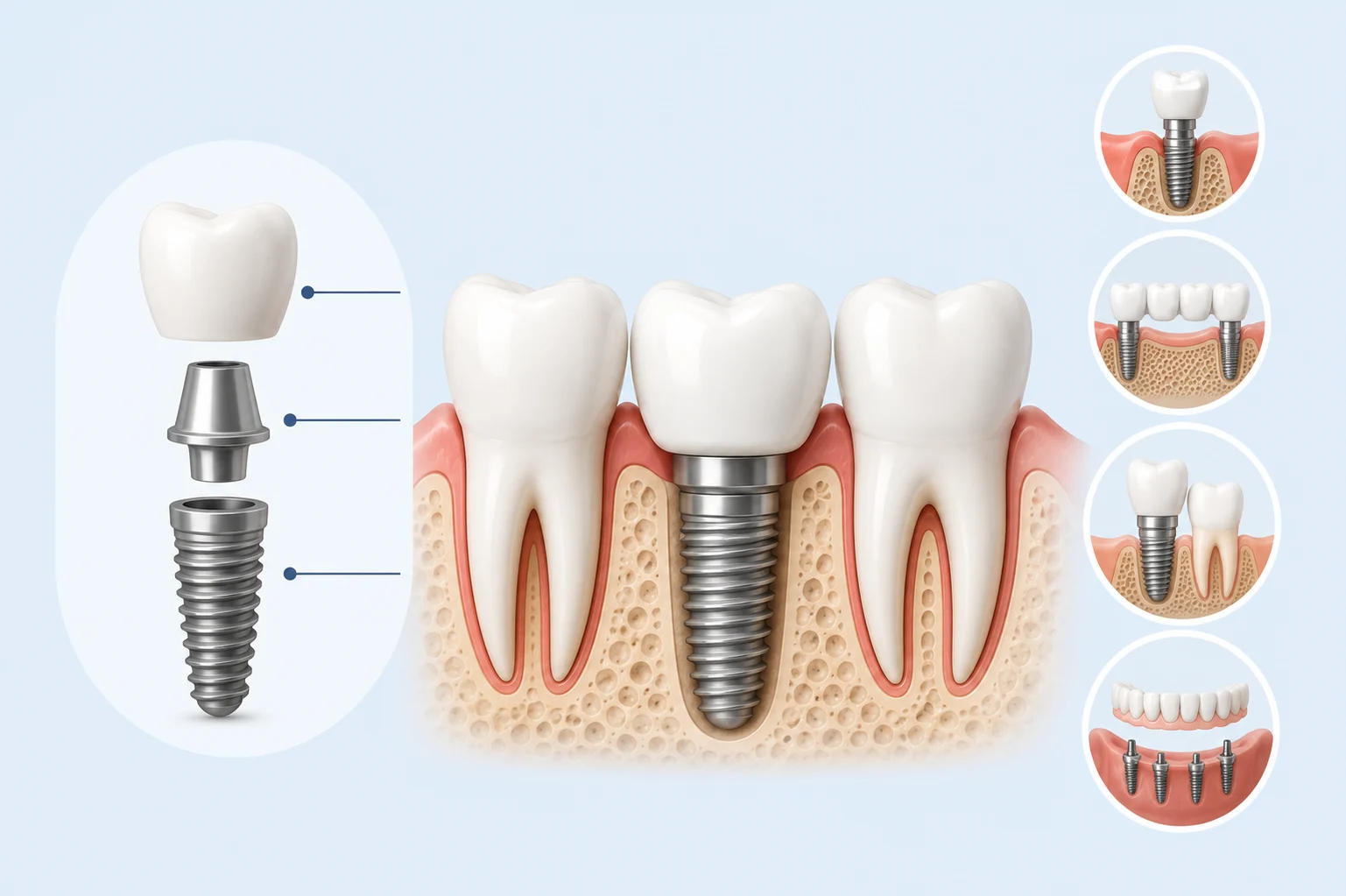
An implant, sometimes called a fixture, is a titanium or titanium alloy post that is surgically placed into the jawbone to replace the root of a missing tooth. This is the portion of the implant that sits beneath the gum tissue and gradually fuses with the surrounding bone.
Titanium is used because it is biocompatible, meaning it is well accepted by the body and allows the jawbone to naturally bond with the implant during a process called osseointegration.
Abutment
An abutment is the small connector that attaches to the dental implant and supports the final restoration. Once the implant has fully integrated with the jawbone, the abutment provides the connection between the implant and your custom crown, bridge, or denture.
Crown
A dental crown is the most common type of final restoration used for a single dental implant. It is custom designed to match the size, shape, and color of your surrounding natural teeth, restoring both appearance and function.
Depending on your treatment plan, the final restoration may be a crown, bridge, or implant supported denture.
Part 2: Surgical and Procedural Terms
Tooth Extraction
A tooth extraction is the surgical removal of a tooth that can no longer be saved because of damage, decay, or periodontal disease.
When a tooth extraction is necessary before implant placement, preserving healthy bone and gum tissue helps create the best possible foundation for successful implant treatment.
Bone Graft
A bone graft is a procedure that adds bone to an area of the jaw that does not have enough volume or density to support a dental implant. This is often recommended when a tooth has been missing for an extended period because the jawbone naturally loses volume after a tooth is lost.
Bone grafting material may come from your own body, a donor source, or a synthetic substitute. Your periodontist will recommend the option that is most appropriate for your individual treatment plan.
Sinus Augmentation (Sinus Lift)
A sinus augmentation, also called a sinus lift, is a specialized bone grafting procedure performed in the upper jaw to increase bone height beneath the sinus cavity. This creates the support needed for a dental implant in the upper back teeth, where the sinus cavity sometimes limits the amount of available bone.
Guided Bone Regeneration (GBR)
Guided bone regeneration (GBR) is a technique that combines bone grafting material with a protective membrane to encourage new bone growth where additional support is needed. The membrane helps create the ideal environment for bone regeneration while preventing unwanted soft tissue from growing into the area.
Osseointegration
Osseointegration is the biological process in which the jawbone gradually bonds with the surface of the titanium implant, creating a stable foundation for the final restoration.
According to the Academy of Osseointegration, this process typically takes between three and six months and is one of the most important factors in the long term success of a dental implant.
Part 3: Terms Related to Your Care Team
Periodontist
A periodontist is a dental specialist who completes several additional years of advanced training beyond dental school, focusing on the gums, jawbone, and the tissues that support teeth and dental implants.
This advanced training is why periodontists perform procedures such as dental implant placement, bone grafting, periodontal surgery, and many tooth extractions. If you're preparing for your first appointment, learning what to expect during your first visit with a periodontist can also help you feel more prepared.
Restorative Dentist
A restorative dentist is typically your general dentist, who designs, places, and maintains the final restoration after the implant has fully healed. Depending on your treatment plan, this may be a crown, bridge, or implant supported denture.
Interdisciplinary Care
Interdisciplinary care means your periodontist and restorative dentist work together throughout your treatment. Your periodontist focuses on the surgical aspects of care, while your restorative dentist completes the final restoration.
This collaborative approach is widely recognized as the gold standard in modern dentistry because it allows each provider to focus on their area of expertise while working together to achieve the best possible outcome for every patient.
A Note on Nuance: Not Every Term Applies to Every Patient
Not every patient will encounter every term in this glossary, and that's completely normal.
Every treatment plan is personalized. Some patients with healthy bone and recently lost teeth may move directly to implant placement, while others may benefit from procedures such as bone grafting before an implant can be placed. Your periodontist will recommend only the treatments that are appropriate for your individual needs. Factors that affect treatment planning can also determine whether someone is a good candidate for dental implants.
A comprehensive consultation, including advanced 3D cone beam CT imaging, allows your periodontist to evaluate your oral health, determine whether any additional procedures are needed, and develop a personalized treatment plan designed for long term success.
Moving Forward with Confidence
Dental implant terminology may seem unfamiliar at first, but each term describes an important part of your treatment. Understanding the language of implant dentistry can help you feel more comfortable during consultations, better understand your treatment recommendations, and make informed decisions about your care.
If you're considering dental implants in Charlotte, our Board Certified periodontists are here to answer your questions, explain your treatment options, and guide you through every stage of care. For more than 50 years, CharlottePerio has been committed to providing specialized periodontal care with advanced technology, personalized treatment planning, and close collaboration with your general dentist. Our goal is to help you restore your smile with results that support your long term oral health.
Patients can review what to eat after dental implant surgery as part of preparing for the healing period.
Frequently Asked Questions on Dental Implant Terms
What is the difference between an implant and a crown?
The dental implant is the titanium or titanium alloy post that is surgically placed into the jawbone to replace the root of a missing tooth. A dental crown is the most common type of final restoration and is the visible, tooth shaped portion that restores the appearance and function of your smile. The implant and crown are connected by a small component called the abutment.
Who performs the surgical part of a dental implant procedure?
A periodontist typically performs the surgical portions of dental implant treatment, including tooth extractions, bone grafting, and implant placement. Because periodontists receive several additional years of advanced training focused on the gums, jawbone, and supporting structures of the teeth, they are uniquely qualified to perform these procedures. Your restorative dentist then designs and places the final restoration once healing is complete.
Why do some patients need a bone graft and others don't?
Bone grafting is recommended when there is not enough healthy jawbone to properly support a dental implant. This often occurs after a tooth has been missing for an extended period, as the jawbone naturally loses volume over time. Patients with healthy existing bone may be able to proceed directly to implant placement without additional grafting.
When would someone need a sinus augmentation?
A sinus augmentation, also called a sinus lift, may be recommended when a dental implant is planned in the upper back jaw and there is not enough bone between the jawbone and the sinus cavity to securely support the implant. This procedure is performed only when it is necessary to create a stable foundation for long term implant success.
How is osseointegration different from normal healing?
The gum tissue around a dental implant often heals within the first few weeks after surgery, but osseointegration is a much longer biological process. During osseointegration, the jawbone gradually bonds with the implant to create a stable foundation for the final restoration. This process typically takes between three and six months and occurs beneath the surface, so patients usually do not feel it happening.
What does interdisciplinary care mean for my treatment?
Interdisciplinary care means your periodontist and restorative dentist work together throughout your treatment. Your periodontist focuses on the surgical aspects of care, while your restorative dentist completes your final restoration. This collaborative approach helps ensure every stage of treatment is carefully coordinated to achieve the best possible outcome.
Contact Us
We provide exceptional dental care tailored to your needs.
Contact Us at: (704) 365-0123
Fax: (704) 364-8640
Email: info@charlotteperio.com
Get in Touch
*Name
*Your Email
*Your Phone Number
Additional Information

Our Professional Affiliations






© 2026 CharlottePerio. All Rights Reserved | Notice of Privacy Practices | Digital Marketing by Remedo